
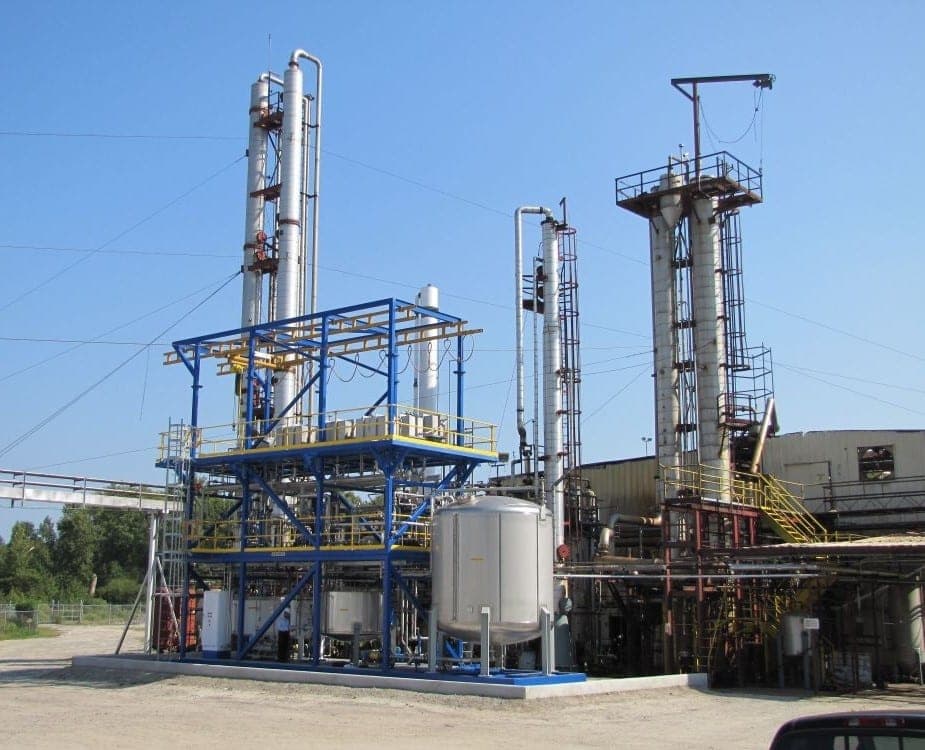
Case study · Chemical & Petrochemical · 2012
200,000 L/day hybrid refinery, solvents recovered at pervaporation scale
An innovative multi-process refinery in Virginia, USA. Petro Sep engineered, fabricated, and deployed AQUA-SEP®, AZEO-SEP®, and VOC-SEP® systems on the same site. Featured as one of the largest pervaporation deployments of its kind.
- Industry
- Chemical & Petrochemical
- Location
- Virginia, USA
- Year
- 2012
- Technology deployed
- PV + VP + VMD
Outcomes
The numbers that mattered.
- Project capacity
- 200,000 L/day
- Multi-process refinery scope.
- Technologies combined
- 3
- AQUA-SEP®, AZEO-SEP®, and VOC-SEP® on the same site.
- Scope ownership
- End to end
- Design, fabrication, installation, and commissioning by one team.
01
The problem
A multi-process refinery handling solvents needs several separations at once. Distillation alone cannot break solvent azeotropes, reverse osmosis cannot finish high-TDS aqueous streams, and volatile organics have to come out of the water before it can be reused or discharged.
02
Why a hybrid AQUA-SEP + AZEO-SEP + VOC-SEP design
Petro Sep's three productized platforms each target one of those separations. AQUA-SEP® (vacuum membrane distillation) handles the high-TDS aqueous streams that RO cannot touch. AZEO-SEP® (pervaporation) breaks the azeotropic and close-boiling solvent mixtures distillation alone cannot resolve, with no entrainer column required. VOC-SEP® (hydrophobic pervaporation) removes volatile organic compounds from water and recovers them for reuse. Petro Sep describes the result as an innovative multi-use, multi-process refinery.
03
On the record
Petro Sep's 2024 project highlights list the Virginia hybrid refinery as a completed 2012 solvents project with a production capacity of 200,000 L/day, and its 2024 company profile shows AQUA-SEP®, AZEO-SEP®, and VOC-SEP® combined on the one site.
Gallery
From the field.
Photographs from fabrication, installation, and commissioning.
Industry
More on Chemical & Petrochemical.
Code-stamped process equipment and patented separation for chemicals, solvents, polymers, and refineries.
Explore industry
Technology
How Pervaporation works.
Selective separation of liquid mixtures, including the azeotropes that distillation cannot break.
Specs and applications
Have a similar feed
we should look at?
Send us a sample and a sentence about your goal. We will tell you whether membrane separation fits and what we would do at each of the five steps.