
Productized platform
AQUA-SEP®
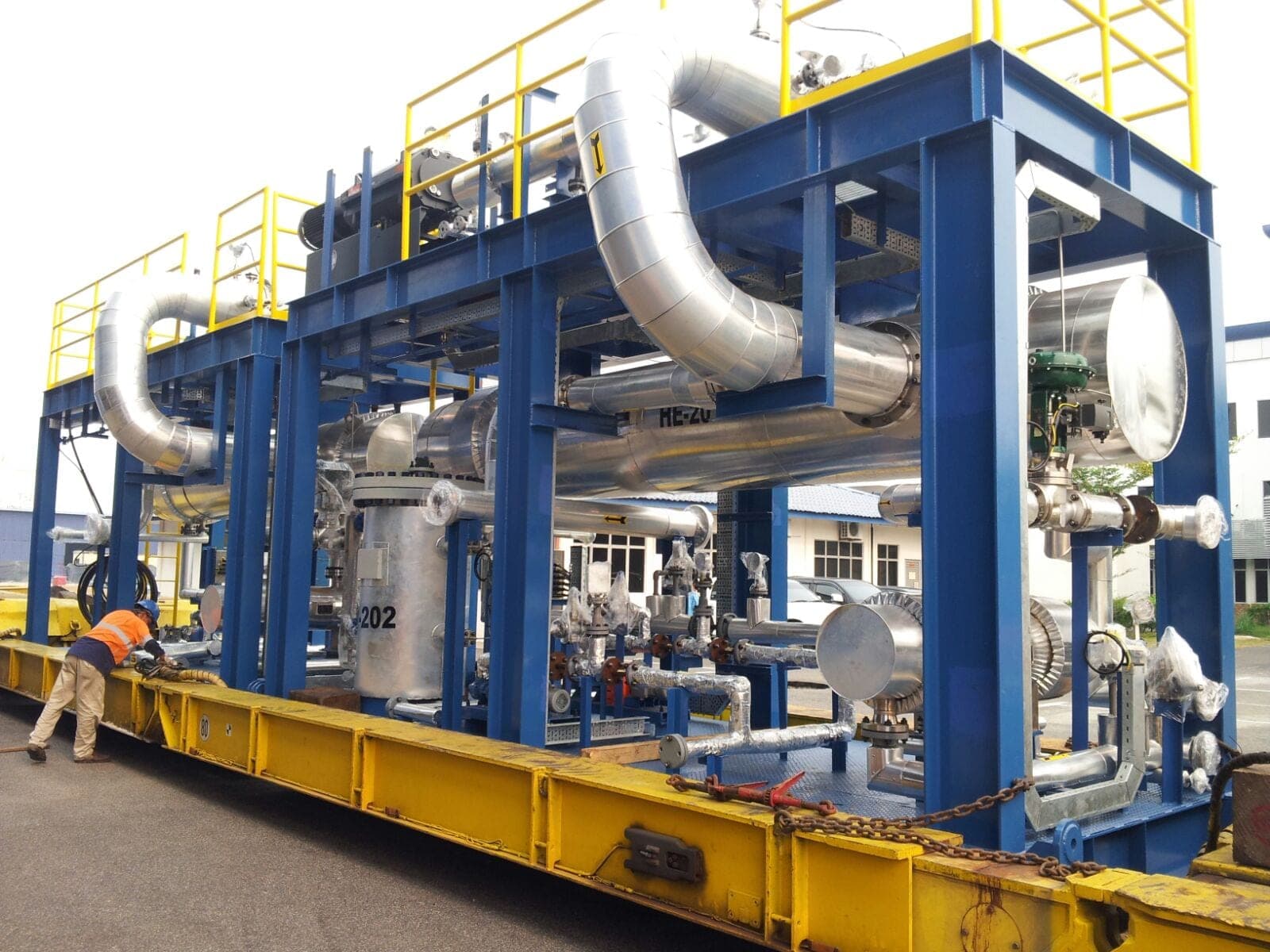
AQUA-SEP® is Petro Sep's vacuum membrane distillation platform, standardized into a system you can size and quote. The feed runs along one side of a hydrophobic, microporous membrane while the other side is kept under vacuum; water passes through the pores as vapor, and almost all of the dissolved salts stay behind. Petro Sep's brochure says it can treat reject brine from desalination plants and from RO and seawater RO (SWRO) plants, and toxic wastewater.
AQUA-SEP® delivers
What the platform delivers.
Productized does not mean compromised. AQUA-SEP® was tuned to the applications that asked for it most.
- Water recovery, standalone
- 85 to 90%+
- Vacuum membrane distillation, on tested feeds: produced water, mining brines, RO reject.
- Water recovery, RO + AQUA-SEP hybrid
- Up to ~95%
- RO at ~40% recovery, AQUA-SEP at the tail.
- Recovered water purity
- <10 mg/L TDS
- 99.99% pure on a TDS basis. Independently testable on your own feed.
- Electricity vs evaporator + crystallizer
- 26 vs 43
- kWh/m³ for the 100 GPM unit, with 129 vs 300 kWh/m³ of utilities, per the AQUA-SEP Energy Comparison data sheet. Drops further on sites with waste heat.
Performance envelope
Sizes, materials, options.
Capacity scales by adding skids in parallel. Materials and code stamps configure to your jurisdiction. We document every option in the proposal package.
- Maximum feed TDS
- Up to 25%+(250,000 mg/L)
- Flux rate
- Up to 25kg/m²·h
- Standard plant range (packaged systems)
- 50 to 1,000m³/day
- Operating temperature
- 60 to 80°C
- Max operating pressure
- 200kPa
- Permeate quality
- <10mg/L TDS (99.99% pure)
- Footprint, 100 m³/day plant
- 2 skids5.5 × 5.5 × 5 m and 6.5 × 2.5 × 5 m
- Specific energy (100 GPM unit)
- 26 + 129kWh/m³ (electricity + utilities)
- Membrane materials
- PE, PP, PVDF and others
- Form factor
- Hollow fiber (preferred) or flat sheet
- Code stamps
- ASME 'U', 'U2'; NB 'R'(Kerteh shop)
- Materials of construction
- Stainless 316L standard; duplex and Hastelloy options
Energy comparison
AQUA-SEP® vs evaporator + crystallizer.
Published energy figures for a 100 GPM unit, AQUA-SEP® versus a conventional evaporator + crystallizer alternative. Source: Petro Sep AQUA-SEP Energy Comparison data sheet.
| System | Electrical energy (kWh/m³) | Utilities (kWh/m³) |
|---|---|---|
| AQUA-SEP® | 26 | 129 |
| Evaporator + crystallizer | 43 | 300 |
For the 100 GPM unit, AQUA-SEP® uses less on both lines: 26 against 43 kWh/m³ of electricity and 129 against 300 kWh/m³ of utilities. The advantage widens further on sites with waste heat available to drive the vacuum distillation loop.
Built on
Vacuum Membrane Distillation.
Membrane distillation under vacuum, built as AQUA-SEP®, for brines, RO reject and high-salinity wastewater.
AQUA-SEP® is the productized application of our vacuum membrane distillation technology. The technology page is where engineers go for the working principle, full specs, and how it compares to alternatives.
Why this matters to a buyer
- The system is the same platform we already ship at scale; no first-of-a-kind risk.
- If a custom configuration is needed beyond the standard envelope, we engineer it on the same platform.
Where it's deployed
Industries that buy this system.
AQUA-SEP® is in service across multiple sectors. Click through to see the specific applications and outcomes by industry.
Oil, Gas & Energy
Process equipment, packaged plants, and membrane separation for upstream, midstream, downstream, and energy.
Learn more
Mining
Process plants and membrane separation for tailings, brines, lithium, and ZLD.
Learn more
Industrial Manufacturing & Environmental
Process equipment, packaged plants, and membrane recovery for manufacturing, water reuse, and emissions control.
Learn more
Ready to size
AQUA-SEP® for your feed?
Send us your fluid composition and a target capacity. We will send back a sized configuration, expected performance, and an indicative budget promptly.