By the Petro Sep engineering team
Published Updated
The pervaporation process, step by step
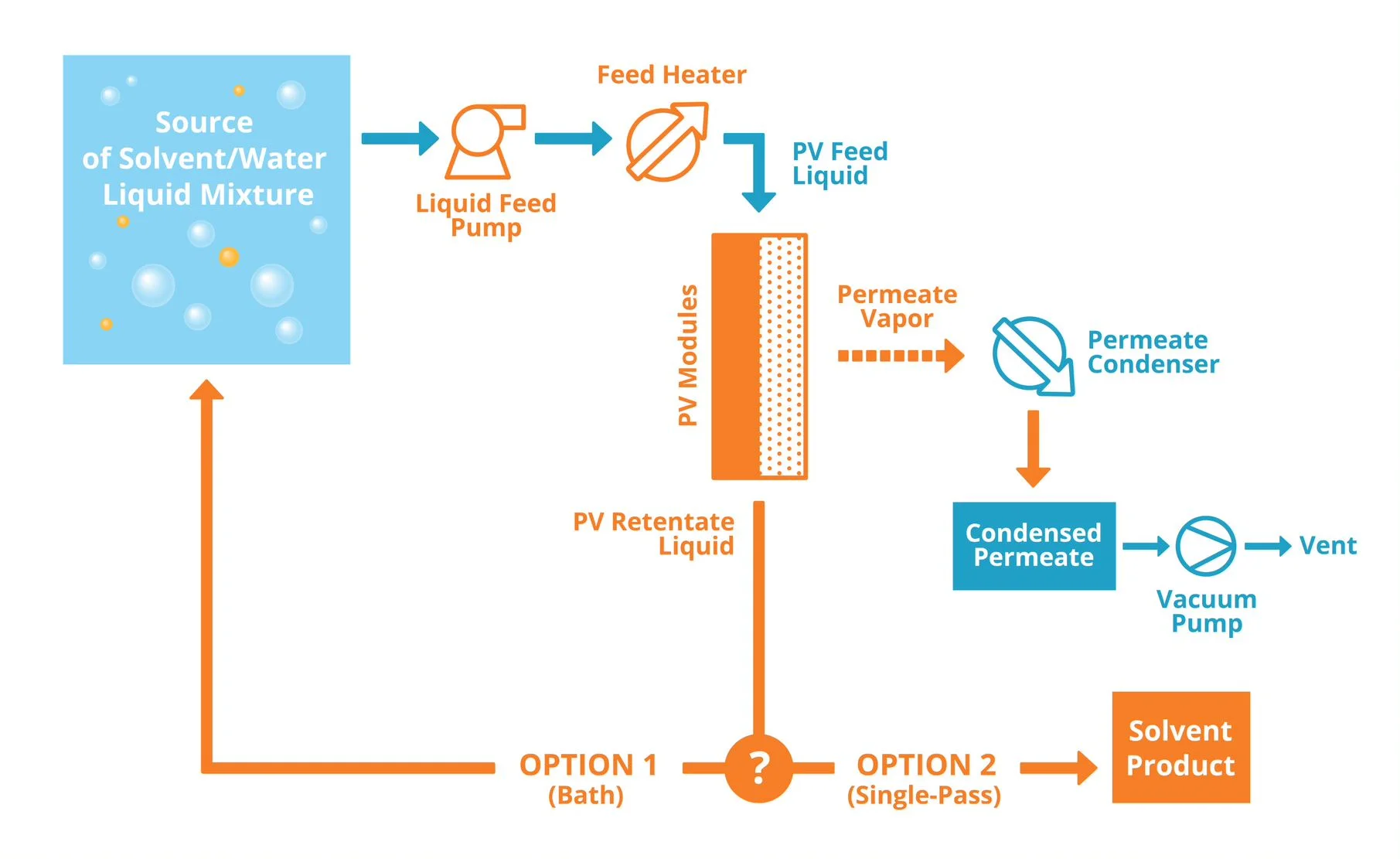
A heated liquid feed flows past the membrane; the component that permeates sorbs into it, diffuses through and desorbs as vapor into a vacuum, where it is condensed, while the rest of the feed, usually reheated between stages, leaves as the retentate.
- Feed preparation and heating. The feed is brought to temperature before it reaches the membranes. In Petro Sep's AZEO-SEP® units the feed is heated, in the batch tank or ahead of the first module, and a feed pump moves it; AZEO-SEP operates at 75 to 85 °C (167 to 185 °F). A hotter feed permeates faster.
- Sorption. On the feed side, the component with the stronger affinity for the membrane dissolves into its dense surface: water into a hydrophilic membrane, organics into a hydrophobic one.
- Diffusion. The dissolved molecules diffuse across the membrane. The permeate's composition is set by how readily each component dissolves in the membrane and diffuses through it, not by the vapor-liquid equilibrium, so a component at low concentration in the feed can be highly enriched in the permeate.
- Desorption under vacuum. At the downstream face the permeate evaporates into the permeate side, which a vacuum pump holds at low pressure. The difference between the permeating component's partial pressure on the feed side and on the vacuum side drives the transfer. In AZEO-SEP's continuous units the modules sit in vacuum chambers.
- Condensing the permeate. The vapor is condensed to a liquid. AZEO-SEP condenses the permeate ahead of the vacuum pump, which removes the gases that do not condense; VOC-SEP® condenses the vapor leaving the vacuum pump, recovering the organics as a liquid.
- Reheating between stages. The heat that evaporates the permeate comes out of the liquid feed, so the feed cools along the membrane and the flux falls with it. Plants therefore usually split the membrane area into modules in series with heaters between them; in AZEO-SEP's continuous units, inter-stage heaters supply the heat of vaporization for a higher removal of the permeating component.
- The retentate. What does not cross leaves the last module as the retentate, concentrated in the components the membrane holds back. In solvent dehydration that is the dried solvent, the product; in VOC removal it is the treated water.
In a batch unit the retentate returns to a heated feed tank, and steps 2 to 5 repeat with each pass until the target purity is reached. The terms used here are defined in the membrane glossary.
What drives the separation?
A partial-pressure difference: the permeating component's partial pressure is higher on the feed side than in the vacuum on the permeate side, and the component moves down that gradient.
The membrane decides which component moves: what crosses, and how readily, depends on each component's affinity for the membrane and its diffusion rate through it, not on the vapor-liquid equilibrium. Petro Sep's AZEO-SEP brochure says the separation is mainly due to the components' difference in polarity, not in volatility. Vacuum is the usual way to create the driving force, and Petro Sep's systems use a vacuum pump; a sweep gas or a temperature difference can do the same job. Temperature matters as well: in a 2024 pilot study, a hotter feed raised the flux and shortened the time needed to reach the target dehydration.
Hydrophilic vs hydrophobic pervaporation membranes: what is the difference?
A hydrophilic membrane lets water through and dries an organic solvent; a hydrophobic, or organophilic, membrane lets organics through and leaves the water behind.
The steps are the same in both; the membrane's affinity sets the direction. Petro Sep's cellulosic ethanol presentation sums it up: AZEO-SEP takes the water out, and VOC-SEP, the opposite technology, keeps the water in the feed. Industrial pervaporation membranes are generally composites, a thin, dense selective layer coated on a porous support. A third kind, organic-organic pervaporation, separates one organic from another (methanol from MTBE is a studied case).
| Hydrophilic pervaporation | Hydrophobic (organophilic) pervaporation | |
|---|---|---|
| What permeates | Water | Volatile organic compounds (VOCs) |
| What stays behind | The dried solvent, which is the product | The treated water |
| Typical job | Dehydrating solvents, including past an azeotrope | Removing and recovering organics from process water and wastewater |
| Membrane materials in the literature | PVA, chitosan, polyimide; NaA zeolite | PDMS, PTMSP; MFI zeolite |
| Petro Sep platform | AZEO-SEP | VOC-SEP |
| Petro Sep membrane and module | A non-porous hydrophilic membrane in pervaporation modules; continuous units house the modules in vacuum chambers | Modules made from proprietary polymeric hollow-fiber membranes |
| Feed in Petro Sep's documents | The brochure's hybrid example sends an 80% ethanol column overhead to the membranes | 0.2% to 10% VOCs, ideally organics that boil below water |
Why can pervaporation break azeotropes?
Because what crosses the membrane is set by affinity, not by the vapor-liquid equilibrium that stops distillation at the azeotrope.
At an azeotrope the vapor and the liquid have similar compositions, so distillation alone can go no further: ethanol and water form an azeotrope at 95.6% ethanol by mass, and isopropanol and water form another. Pervaporation does not depend on that equilibrium, so a suitable membrane can take the separation past the azeotropic point; in the AZEO-SEP brochure's words, its membrane selectivity "is not affected by azeotrope formation". For ethanol and water, two distillation routes past the azeotrope, extractive and azeotropic distillation, both need high energy, and azeotropic distillation uses highly toxic solvents. AZEO-SEP adds no chemicals. The options are compared under breaking azeotropes.
What can pervaporation separate, and where is it used?
Water out of organic solvents, its main industrial use; organics out of water; and one organic from another.
In industrial solvent purification it is applied mainly to dehydrating ethanol and isopropanol. Petro Sep's AZEO-SEP brochure adds these uses: recovering spent solvents in pharmaceutical and chemical plants, where solvents often form azeotropes with water; raising the throughput of distillation columns whose feed components differ little in volatility; raising the yield of equilibrium-controlled reactions by removing water continuously with an AZEO-SEP and distillation hybrid, as when esters form from acids and alcohols; and drying solvents captured in activated carbon beds and desorbed with steam. VOC-SEP returns valuable organics from waste streams to the process and concentrates wastewater, cutting the volume sent for disposal. See solvent recovery and purification and VOC removal from process water and wastewater.
| Platform | Separation | Solvents named |
|---|---|---|
| AZEO-SEP | Removes water from the solvent | Alcohols: methanol, ethanol, propanol, butanol. Ketones: MEK, MIBK. Ethers: MTBE, ETBE, THF. Esters: methyl, butyl and ethyl acetate |
| VOC-SEP | Removes the organic from water | Acetone, benzene, chloroform, chloroprene, 1,2-dichloroethane, 1,1-dichloroethane, ethanol, ethyl acetate, isopropanol, methyl acetate, MTBE, THF, trichloroethylene |
Ethanol, MTBE, THF, methyl acetate and ethyl acetate appear on both lists: which membrane applies depends on whether water or the organic is the component to remove. Both brochures invite enquiries about solvents that are not listed.
What purity and performance can you expect?
For AZEO-SEP, Petro Sep's documents give 99.5% purity in most applications, with the top of its purity range at 99.9%; Petro Sep offers bench-scale testing to help choose a system for a given mixture.
| Figure | Value | Applies to |
|---|---|---|
| Purity | 99.5% | AZEO-SEP, most applications |
| Top of the purity range | 99.9% | AZEO-SEP |
| Operating temperature | 75 to 85 °C (167 to 185 °F) | AZEO-SEP |
| VOC content of the feed | 0.2% to 10% | VOC-SEP, the range it suits |
| Total alcohols (excluding glycol), raw feed to after the membrane | 108,240 to 53 ppm; 31,650 to 247 ppm; 4,400 to 43 ppm | Lean Water tests: three wastewater batches |
| Water recovered | About 70% of the feed, as "clean" dischargeable water | Lean Water pilot |
| Organics recovered | 95%, as high-BTU fuel | Lean Water pilot |
The pilot's goal was to bring organics down far enough for sewer discharge instead of incineration, and it reached sewer-discharge levels on the three feeds. Flux is not a single figure: it depends on the membrane, the mixture and the temperature.
How is pervaporation configured in a plant?
Petro Sep's AZEO-SEP systems come in three types: a batch loop for smaller throughputs, modules in series for continuous duty at larger throughputs, and a hybrid that takes part of a distillation column's overhead past the azeotrope.
| Configuration | How it runs | Suits |
|---|---|---|
| Batch | Feed is pumped from a heated batch tank through the modules; the permeate is condensed and the retentate returns to the tank, more concentrated with each pass, until the target purity is reached | Smaller throughputs |
| Continuous | A preheated feed passes through a series of modules in vacuum chambers; for a higher removal of the permeating component, inter-stage heaters supply the heat of vaporization; a condenser collects the permeate and a vacuum pump removes what does not condense | Larger throughputs, typically in a manufacturing plant |
| Hybrid with a distillation column | Part of the column overhead (80% ethanol in the brochure's example) passes through the modules; the dried product leaves as retentate, and the condensed permeate, at 5 to 20% ethanol, returns to the column | Breaking the azeotrope on a distillation column; raising the throughput of a column whose feed components differ little in volatility |
In the hybrid, the column does the first separation and the membrane takes the overhead past the azeotrope to the final dehydration. Petro Sep also states that a hybrid unit on a column with low volatility differences "will increase throughput and reduce operating costs". VOC-SEP units can be designed for batch or continuous operation, depending on the volume to be treated, and continuous units may need several modules in series to reach the desired separation. Petro Sep supplies skid-mounted units on a turnkey basis; system choices for a given plant are covered under pervaporation systems.
How does pervaporation compare with distillation and molecular sieves?
For drying ethanol, it can replace entrainer distillation or molecular sieves, or work alongside them: distillation separates by volatility up to the azeotrope, molecular sieves adsorb the water and have to be regenerated, and pervaporation removes water continuously through a membrane.
- Distillation separates components that differ in volatility and boiling point. It can bring ethanol from a fermentation broth close to the azeotrope, but it cannot pass an azeotrope on its own, and columns separating components with low volatility differences need high reflux.
- Molecular sieves are widely used adsorbents for drying ethanol. The adsorbent has to be regenerated, and the desorption step needs high temperature, low pressure or both, which weighs on process cost.
- Pervaporation runs continuously, needs no added chemicals and combines readily with other processes. Only the permeate evaporates, so the latent heat goes to the permeate alone; heating the feed, the vacuum pump and cooling the condenser use energy too. It can be added to an existing entrainer-distillation or molecular-sieve unit rather than replacing it.
What are the limits of pervaporation?
It needs steady heat input and a membrane matched to the mixture, and in a hybrid with distillation it is suited to extracting the component at lower concentration in the feed.
- Solids. When dissolved or undissolved solids are present in the feed, one practice is to evaporate it first and use vapor permeation instead.
- Heat. Evaporating the permeate cools the feed; the temperature drop limits the size of a module, and staged reheating needs heat exchangers between modules.
- Membrane stability. The membrane has to keep its transport properties despite swelling and concentration polarization. Organic-organic mixtures are harder for polymeric membranes, because polymers swell much more in pure organic solution.
- The minor component. Studies of distillation-pervaporation hybrids for azeotropes found it expedient to let the membrane extract the component at lower concentration in the feed. VOC-SEP suits feeds with 0.2% to 10% VOCs.
- Volatility, for VOC-SEP. The organics should boil below water for optimum performance, and the degree of separation is limited by the equilibrium of the VOCs between the liquid and vapor phases.
- Scale and cost. A 2022 study names production capacity and installation cost as the limitations of pervaporation.
Where has Petro Sep used pervaporation?
Petro Sep's documents record plants using its pervaporation systems in China (2008), Virginia (2010 and 2012) and Sarnia (2016), and a six-month pilot of a stripping column with VOC-SEP on three industrial wastewaters.
| Year | Location | What the documents record | Platforms |
|---|---|---|---|
| 2008 | China | Full-scale plant for VOC removal from a hazardous aqueous stream | VOC-SEP |
| 2010 | Virginia, USA | Refinery and plant | AZEO-SEP |
| 2012 | Virginia, USA | Hybrid refinery, "an innovative multi-use multi-process refinery" | AQUA-SEP®, AZEO-SEP and VOC-SEP |
| 2016 | Sarnia, Canada | Small hybrid refinery for bioethanol and acetone-butanol-ethanol (ABE); the photo index also lists an AZEO-SEP plant skid at Sarnia that year | AZEO-SEP, VOC-SEP and AQUA-SEP |
| Not dated | Sarnia pilot plant | "Lean Water" pilot: three industrial wastewaters with 5 to 15% organics, run for six months through a stripping column plus VOC-SEP | VOC-SEP |
The case studies are the Virginia hybrid refinery and the Sarnia bioethanol and ABE plant. Petro Sep's Company Profile also shows a VOC-SEP unit in Canada and a food-grade hybrid AZEO-SEP, AQUA-SEP and VOC-SEP project in China, without dates. Its project table lists completed solvent projects at various US locations from 2005 to 2008 (25,000 to 35,000 L/day), a completed 2012 solvents project in Virginia of 200,000 L/day, a 50,000 L/day biofuel plant in Ontario from 2010, and 2023 bioethanol projects of 100,000 L/day each in Canada and Malaysia, listed as ongoing; the table does not name the technology used.
Petro Sep started in 1999 as a membrane research and development company. A 2002 paper by C. K. Yeom, M. Kazi and F. U. Baig, written at Petrosep Membrane Research Inc. in Oakville, "Simulation and Process Design of Pervaporation Plate-and-Frame Modules for Dehydration of Organic Solvents" (Membrane Journal), modeled the dehydration of organic solvents in commercial-scale plate-and-frame pervaporation modules, which hold a stack of membrane sheets. It simulated continuous and batch operation. For a fuller treatment of the process, see Fakhir U. Baig's chapters "Pervaporation", in Advanced Membrane Technology and Applications (Wiley, 2008), and "Pervaporation and Hybrid Vacuum Membrane Distillation Technology and Applications", in Membrane Separation Principles and Applications (Elsevier, 2019).
Pervaporation vs vapor permeation vs membrane distillation: what is the difference?
Pervaporation feeds a liquid to a dense membrane, vapor permeation feeds a vapor to a non-porous membrane as well, and membrane distillation feeds a liquid to a porous, water-repellent membrane whose pores the vapor crosses.
| Pervaporation (PV) | Vapor permeation (VP) | Membrane distillation (MD) | |
|---|---|---|---|
| Feed | Liquid | Vapor | Liquid |
| Membrane | Dense, non-porous | Non-porous, as in PV | Porous, hydrophobic |
| What sets the separation | Sorption and diffusion in the membrane | Sorption and diffusion in the membrane | Volatility: the volatile component crosses the pores as vapor, and non-volatile solutes stay behind |
| Phase change | The permeate evaporates through the membrane | None during permeation | The liquid evaporates at the membrane, and the vapor crosses the pores |
| At Petro Sep | AZEO-SEP and VOC-SEP | Listed among the technologies in its turnkey plants | AQUA-SEP, a vacuum membrane distillation system |
Vapor permeation suits streams that are already vapor, such as the top streams of fractionation columns. More in What is vapor permeation (VP)?, on vapor permeation systems and in What is membrane distillation (MD)?; Petro Sep's vacuum membrane distillation platform is AQUA-SEP.
Frequently asked questions
What does the word pervaporation mean?
Is pervaporation the same as membrane distillation?
Is pervaporation energy efficient?
What temperature does pervaporation run at?
Does pervaporation replace a distillation column?
Are any chemicals added?
What flux should I expect?
What is vapor permeation?
Sources
- Petro Sep, AZEO-SEP® brochure.
- Petro Sep, VOC-SEP® brochure.
- Petro Sep, AQUA-SEP® brochure.
- Petro Sep, General Presentation (January 2024).
- Petro Sep, Company Profile (January 2024).
- Petro Sep, Project photo index (2023).
- Petro Sep, Cellulosic Ethanol Production presentation (February 2021).
- U.S. Department of Agriculture, National Agricultural Library, NAL Agricultural Thesaurus: pervaporation (Definition from the U.S. Environmental Protection Agency).
- Polymers (MDPI), Pervaporation as a Successful Tool in the Treatment of Industrial Liquid Mixtures (Lakshmy et al., vol. 14, no. 8, article 1604, 2022).
- Química Nova (Sociedade Brasileira de Química), Detailed evaluation of pervaporation modeling to obtaining anhydrous ethanol (Cavalcanti, Ramos, Brito and Brito, vol. 45, no. 4, pp. 374 to 382, 2022).
- Membranes (MDPI), Influence of Process Parameters on the Efficiency of Pervaporation Pilot ECO-001 Plant for Raw Ethanol Dehydration (Kujawska et al., vol. 14, no. 4, article 90, 2024).
- International Conference on Distillation & Absorption, Baden-Baden, Hybrid pervaporation-absorption for the dehydration of organics (Fahmy, Mewes and Ohlrogge (Universität Hannover; GKSS Research Centre), 2002).
- Brazilian Journal of Chemical Engineering (Brazilian Society of Chemical Engineering), Using pervaporation data in the calculation of vapour permeation hollow-fibre modules for aroma recovery (Ribeiro and Borges, vol. 21, no. 4, pp. 629 to 640, 2004).
- Membranes (MDPI), Review of Hybrid Membrane Distillation Systems (Zhang and Xian, vol. 14, no. 1, article 25, 2024).
- RSC Advances (Royal Society of Chemistry), Hydrophilic and organophilic pervaporation of industrially important α,β and α,ω-diols (Chaudhari et al., vol. 11, no. 16, pp. 9274 to 9284, 2021).
- Membrane Journal (The Membrane Society of Korea), Simulation and Process Design of Pervaporation Plate-and-Frame Modules for Dehydration of Organic Solvents (Yeom, Kazi and Baig, vol. 12, no. 4, pp. 226 to 239, 2002).
- Wiley, Pervaporation, in Advanced Membrane Technology and Applications (Fakhir U. Baig, pp. 469 to 488, 2008 (further reading)).
- Elsevier, Pervaporation and Hybrid Vacuum Membrane Distillation Technology and Applications, in Membrane Separation Principles and Applications (Fakhir U. Baig, pp. 233 to 250, 2019 (further reading)).