
By the Petro Sep engineering team
Published Updated
What is Membrane distillation?
Membrane distillation (MD) is a thermally driven, membrane-based separation process that uses a porous, hydrophobic membrane to separate non-volatile solutes from water. A temperature difference across the membrane creates a vapor pressure gradient, so only vapor molecules pass through the membrane pores while liquid water and dissolved solids are held back on the feed side. The vapor then condenses on the cooler permeate side as high-purity product water.
How membrane distillation works
In an MD process, a microporous hydrophobic membrane is in contact with a heated aqueous solution on one side, known as the feed or retentate. The hydrophobic nature of the membrane blocks mass transfer in the liquid phase and creates a vapor-liquid interface at the entrance of each pore. Only vapor molecules are allowed to penetrate the pores. The driving force is the vapor pressure difference across the membrane, which is set up by the temperature difference between the two sides. Volatile compounds travel through the pores as vapor and condense on the permeate side, while non-volatile solutes stay behind in the feed.
The four main MD configurations
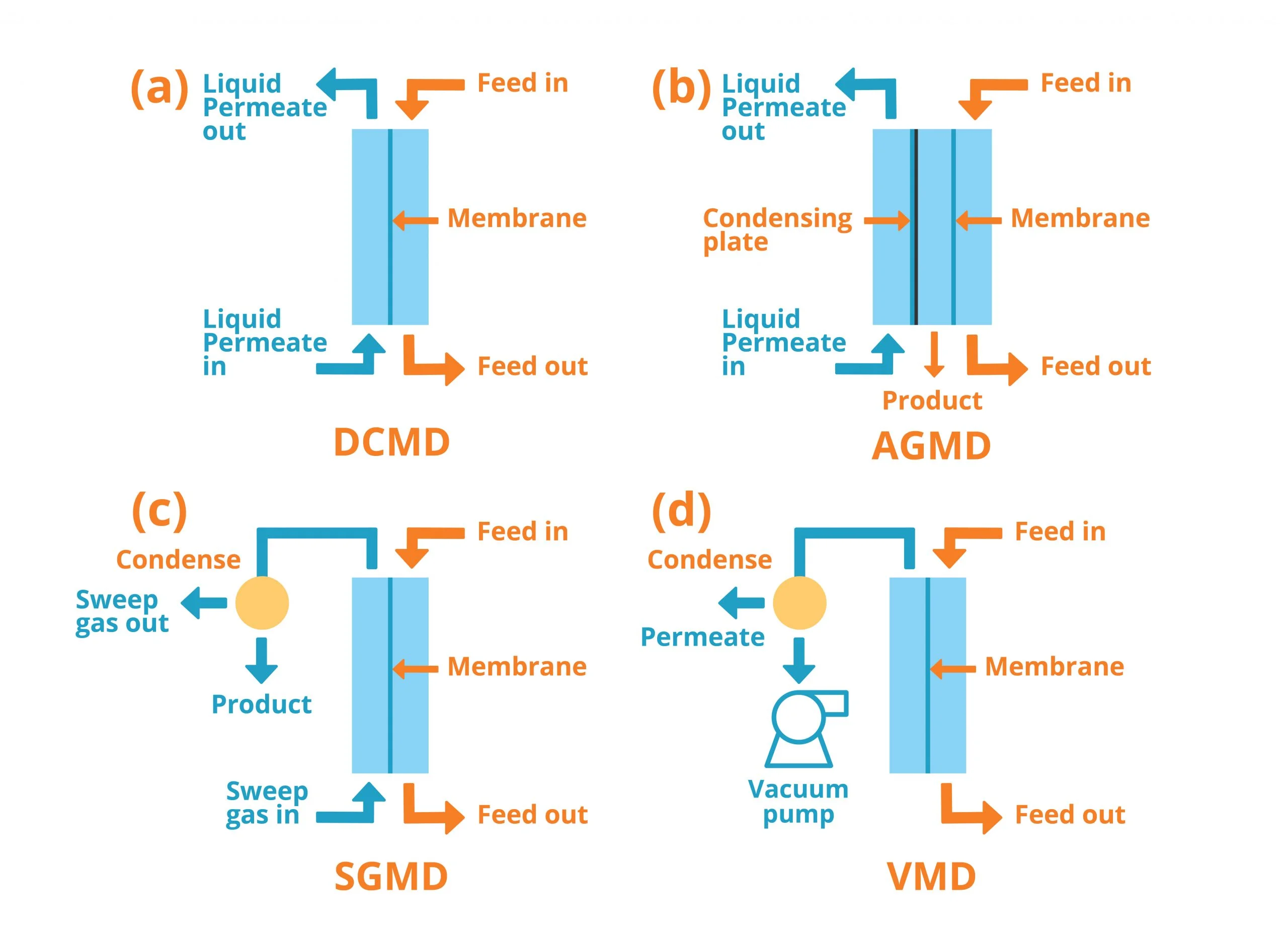
MD is run in several arrangements, distinguished by how vapor is condensed or removed on the permeate side. Direct Contact MD (DCMD) keeps the membrane in direct contact with both the feed and the permeate. Air Gap MD (AGMD) places an air gap between the membrane and a cold condensation surface. Vacuum MD (VMD) applies a vacuum on the permeate side; it is potentially the most efficient configuration, because no heat is lost through the membrane, and it is a better option than DCMD for desalting feeds with high salt concentrations. Desalting seawater and producing clean water from brackish water are the most common VMD applications. Sweeping Gas MD (SGMD) uses a moving gas stream to carry vapor away from the membrane and is typically used to strip volatile organics or dissolved gases.
Where membrane distillation is used
MD is applied wherever high-purity water or concentrated product is the goal. Common uses include distilled water production and solution concentration, seawater desalting and brackish water purification, and water purification for the pharmaceutical, chemical, and textile industries. It is also used to concentrate fruit juice and milk, to remove water from blood in biomedical applications, to concentrate cooling liquids such as glycols, and to process non-volatile acids and oil-in-water emulsions. In textile wastewater treatment, MD supports dye removal.
Why choose membrane distillation
MD has the ability to use low-grade and inexpensive heat sources, a smaller plant footprint, and lower capital costs than conventional distillation processes. Because the membrane rejects non-volatile ionic particles, MD can reach high purity of 99.5 percent and above. It is also suitable for heat-sensitive materials, and the approach can be customized to the separation requirements of a given industry. These traits make MD attractive where waste heat is available or where thermal or reverse-osmosis routes are constrained.
Key points
- Membrane distillation (MD) is a thermally driven separation process that uses a porous, hydrophobic membrane to separate non-volatile solutes from water.
- The driving force is a vapor pressure difference created by a temperature difference across the membrane; only vapor passes through the pores.
- Four main configurations exist: Direct Contact (DCMD), Air Gap (AGMD), Vacuum (VMD), and Sweeping Gas (SGMD).
- MD can run on low-grade or inexpensive heat, uses a smaller footprint, and carries lower capital cost than conventional distillation.
- MD can reach high purity of 99.5 percent and above and is suitable for heat-sensitive materials.
- Applications range from desalination and distilled water to food concentration, pharmaceuticals, biomedical use, and textile wastewater treatment.
- Petro Sep applies MD through AQUA-SEP, its VMD-based separation system.
How Petro Sep applies this
Petro Sep has developed AQUA-SEP, a membrane distillation system based on the vacuum membrane distillation (VMD) principle for separation. Beyond the product, Petro Sep supports the full lifecycle of an MD project through its core services: Research and Scoping to define the separation problem, Engineering and Development to design the system, Fabrication and Installation to build and deploy it, and Operations Management to keep it running. This lets clients move from a bench concept to an installed, operating separation system with a single process-solutions partner.
Sources
- Petro Sep, Membrane Distillation (MD) (petrosep.com page, replaced in July 2026).
- Petro Sep, AQUA-SEP® brochure.