By the Petro Sep engineering team
Published
What is a membrane pilot program?
A program of tests that takes a separation from a sample to a plant design: a feasibility study, bench-scale tests in the lab, a pilot on the real feed, and a report that sets the plant's design parameters.
Bench tests screen membranes on a small sample. The US Environmental Protection Agency (EPA) notes, for example, that reverse osmosis and nanofiltration membranes can be screened for some parameters with flat-sheet or single-element tests. A pilot goes further: it runs on the real feed at the site, and the pilot process should be representative of the full-scale system, including any pretreatment the plant will have. Its data size the plant and narrow the uncertainty about footprint and utilities, they help catch conditions that would otherwise go undetected, and the run familiarizes operators with the equipment.
The EPA figures on this page come from its guidance on membrane filtration for drinking water (microfiltration, ultrafiltration, nanofiltration and reverse osmosis), which it offers as general guidance on widely recognized industry practice. AQUA-SEP® uses vacuum membrane distillation, and AZEO-SEP and VOC-SEP use pervaporation, processes that guidance does not cover, so it frames the method, not the numbers for these systems.
How does a pilot program run, from sample to plant?
Stage by stage: a feasibility study and bench tests on a sample, then a pilot unit on the real feed, a report with the design parameters and, if the results support it, the plant itself.
- Feasibility study. Petro Sep's brochures list technical assistance, consulting and feasibility studies on complex fluid separation problems among its services. Its AQUA-SEP deck describes turnkey work that runs from research and feasibility through conceptual design, FEED and detailed engineering to fabrication, construction, and project and operations management.
- Bench-scale tests on a sample. For AZEO-SEP and VOC-SEP, the brochures put bench-scale testing at Petro Sep's Canadian labs and R&D center first among the ways it helps a customer choose the best system. The lab is in Mississauga (Greater Toronto Area); its services are on the lab testing and analytics page.
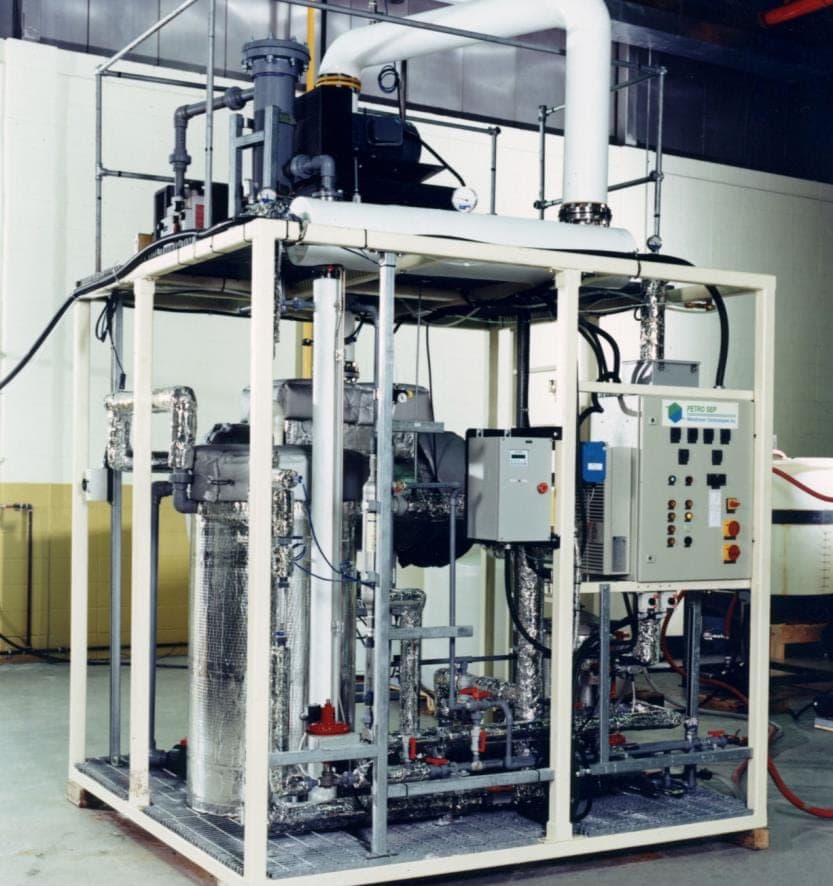
- A pilot unit on the real feed. For AZEO-SEP and VOC-SEP, the same brochures list sales and rentals of bench-scale or pilot plant testing units. In the EPA's guidance, the pilot should match the planned plant, pretreatment included, and the test site supplies the unit's utilities (see "Can you rent or buy a pilot unit?" below). Petro Sep's records include the factory acceptance test (FAT) of a pilot unit in the USA in 2015.
- The pilot report. In the EPA's guidance, the report should hold enough detail to set the full-scale plant's design parameters, to the extent the testing intended. A pilot's result is not necessarily the "optimum" design but a set of operating conditions that is feasible and economic over the expected range of operating and feed conditions.
- Engineering, fabrication and installation. The brochures' third way is customized engineering and design for the application. Petro Sep's Company Profile lists its services as research and development, engineering and design, fabrication and installation, operations management, and collaborations and partnerships. Scale-up is covered on process modeling and scale-up.
What does a pilot measure?
Whether the product meets its target, and the operating data the design depends on; in membrane filtration, the EPA calls flux and system productivity typically the most important design parameters, because they set the number of membranes and with it a large share of the capital cost.
| What is measured | Why it matters | Basis |
|---|---|---|
| Product quality against the target | Shows the treatment objective can be met | EPA guidance |
| Flux and system productivity | They set the number of membranes, a large share of the capital cost | EPA guidance |
| Cleaning frequency | Cleaning stops production, can mean handling harsh chemicals and leaves a waste stream to dispose of | EPA guidance |
| Performance over the feed's range | Testing in the season with the hardest feed keeps the design conservative for year-round operation | EPA guidance |
| Recovery and by-products | In the Lean Water pilot: about 70% of the feed as clean dischargeable water, 95% of the organics as high-BTU fuel | Petro Sep General Presentation |
The EPA adds that only one process variable should be changed at a time. A pilot is also measured against its own goal: in Petro Sep's Lean Water pilot, organic levels low enough for sewer discharge instead of incineration.
How long does a membrane pilot run?
There is no single figure: it depends on how much the feed varies and how often the membranes need cleaning. Petro Sep's Lean Water pilot ran for six months.
For drinking-water filtration, the EPA calls piloting through at least three cleaning cycles recommended practice. For hollow-fiber microfiltration and ultrafiltration, which typically target at least 30 days between cleanings, that means 90 days where possible, and for a more thorough study it usually recommends about 4 to 7 months (3,000 to 5,000 hours) of cumulative operation. It puts nanofiltration and reverse osmosis pilots at about 2 to 7 months (1,500 to 5,000 hours) of cumulative operation, longer for water of variable quality, and says a longer pilot may suit newer, less proven systems. These are general filtration figures, not Petro Sep's; ask for a schedule for your feed.
Can you rent or buy a pilot unit?
For AZEO-SEP and VOC-SEP, yes: Petro Sep's brochures list sales and rentals of bench-scale or pilot plant testing units.
AZEO-SEP units are custom designed, bench-scale or skid-mounted, and supplied on a turnkey basis, either stand-alone or as part of a hybrid separation process. VOC-SEP units are skid-mounted and compact, for ease of transport and installation. Pilot plant fabrication is covered on the pilot and demonstration plants page.
Whoever supplies the unit, the test site has to host it. The EPA's list: utilities such as water, electricity and air; plumbing for the feed, filtrate and concentrate; disposal of cleaning residuals; an estimate of the labor to operate the unit; and enough space. Ask Petro Sep for unit availability and terms.
Which pilots do Petro Sep's records name?
Three: an AQUA-SEP seawater desalination pilot in Saudi Arabia in 2002, the six-month Lean Water pilot on industrial wastewater at a pilot plant in Sarnia, and a pilot unit put through factory acceptance testing in the USA in 2015.
| Year | Where | What the records say | Technology |
|---|---|---|---|
| 2002 | Saudi Arabia | Modular skid for seawater desalination, captioned a desalination pilot | AQUA-SEP |
| Not dated | Sarnia, Canada (pilot plant) | Three industrial wastewaters with 5 to 15% organics, tested over six months | Stripping column with VOC-SEP |
| 2015 | USA | Pilot unit factory acceptance test (FAT) | Water treatment; listed under AQUA-SEP in the project photo index |
Saudi Arabia, 2002: AQUA-SEP seawater desalination pilot
Petro Sep's Company Profile records a modular AQUA-SEP® skid for seawater desalination in Saudi Arabia in 2002, and its project photo index captions the skid a desalination pilot. AQUA-SEP is Petro Sep's hollow-fiber vacuum membrane distillation (VMD) system for purifying water, including very high-salinity brines. More on the Saudi Arabia desalination pilot page and the AQUA-SEP page.
Sarnia: the Lean Water pilot
Over six months, a stripping column combined with VOC-SEP® cut the organics in three industrial wastewaters, with 5 to 15% organics, to sewer discharge levels.
The goal was to cut the organic levels enough for sewer discharge instead of incineration, and the organics reached sewer discharge levels on all three feed types. About 70% of the feed was recovered as clean dischargeable water, and 95% of the organics as high-BTU fuel. The pilot's flow sheet sends sludge (about 15% of the feed volume) to landfill, water (about 70%) to the municipal sewer and a VOC stream (about 15%) to sale. VOC-SEP is Petro Sep's pervaporation system for removing volatile organic compounds from water; more on the VOC-SEP page.
The same presentation reports Lean Water test results on three wastewater batches. The slide does not say whether these are the pilot's three feeds. It sums the tests up as having "reduced all contaminants to well below water discharge limits" and recovered 70% of the feed as "clean" water, without naming the limits.
| Parameter | Batch | Raw feed | After membrane | After carbon |
|---|---|---|---|---|
| Total alcohols, excluding glycol | 1 | 31,650 | 247 | 13 |
| Total alcohols, excluding glycol | 2 | 4,400 | 43 | 49 |
| Total alcohols, excluding glycol | 3 | 108,240 | 53 | 42 |
| Total hydrocarbons, including acetones | 1 | 10,921 | 8 | 1 |
| Total hydrocarbons, including acetones | 2 | 439 | 7 | 8 |
| Total hydrocarbons, including acetones | 3 | 8,786 | 9 | 8 |
| Total solids, including TKN | 1 | 7,607 | 386 | 207 |
| Total solids, including TKN | 2 | 48,879 | 681 | 423 |
| Total solids, including TKN | 3 | 117,856 | 414 | 323 |
USA, 2015: a pilot unit's factory acceptance test
Petro Sep's Company Profile records the factory acceptance test (FAT) of a water treatment pilot unit in the USA in 2015, and its project photo index lists the same entry under AQUA-SEP.
China, 2014 and 2015: membrane tests
Petro Sep's records also list two AQUA-SEP test entries in China that they do not call pilots: membrane skid testing for industrial waste and brine concentration in 2014, and membrane testing at a hazardous mining water treatment plant in 2015.
In the lab: tests on frackwater samples
In lab tests on three frackwater samples, reported in Petro Sep's General Presentation (2024), water recovery was 80 to 90% from feeds of 2.4 to 13.8% salt, with 7 to 23 ppm of salt in the recovered water. The slide does not name the system or the lab.
| Sample | Feed salt | Salt in recovered water | Water recovered |
|---|---|---|---|
| Marcellus | 2.4% | 0.001% | 90% |
| Texas | 8.1% | 23 ppm | 88% |
| Western Canada | 13.8% | 7 ppm | 80% |
Frequently asked questions
How long does a membrane pilot test take?
What is the difference between bench-scale testing and a pilot?
Do I need a pilot before buying a membrane system?
Can I rent a pilot unit from Petro Sep?
Where are bench-scale tests done?
What does a pilot report contain?
Which Petro Sep technologies have been piloted?
Has Petro Sep set out a schedule for developing a new process?
Sources
- Petro Sep, AZEO-SEP® brochure.
- Petro Sep, VOC-SEP® brochure.
- Petro Sep, AQUA-SEP® brochure.
- Petro Sep, General Presentation (January 2024).
- Petro Sep, Company Profile (January 2024).
- Petro Sep, Project photo index (2023).
- Petro Sep, AQUA-SEP® presentation deck (undated).
- Petro Sep, Lithium-ion battery recycling presentation (undated).
- U.S. Environmental Protection Agency, Office of Water, Membrane Filtration Guidance Manual (EPA 815-R-06-009, November 2005, chapter 6, "Pilot Testing" (copy hosted by the North Dakota Department of Environmental Quality)).