By the Petro Sep engineering team
Published Updated
Reverse osmosis (RO) runs out of pressure as brine gets saltier. Petro Sep's AQUA-SEP® vacuum membrane distillation (VMD) system carries on from there: it can treat feeds of 25% salt and more and concentrate brine to saturation. On Petro Sep's energy data sheet for a 100 GPM unit, AQUA-SEP uses 26 kWh/m³ of electricity and 129 kWh/m³ of utilities. An evaporator plus crystallizer uses 43 and 300.
What does ZLD mean?
ZLD stands for zero liquid discharge: a plant design in which no liquid waste leaves the site.
Tong and Elimelech (2016) define it as "a wastewater management strategy that eliminates liquid waste and maximizes water usage efficiency." Its outputs are reusable water and solids. ZLD systems first appeared in the 1970s at US power plants along the Colorado River, in response to the river's rising salinity.
Petro Sep uses the term for solvents as well as water: its General Presentation describes VOC-SEP® recovering "both chemicals and water to 'reusable levels'" as zero liquid discharge. The partial version, minimal liquid discharge (MLD), is compared below. Short definitions are in the glossary.
How does a ZLD process work?
A ZLD process takes water out of the waste stream in stages, each handling a smaller and saltier stream than the one before, until what is left is salt.
A 2025 review describes a typical ZLD setup in four steps (pretreatment, pre-concentration, evaporation and crystallization); this guide adds handling the salt as a fifth.
- Pretreatment. Removes what would foul or scale the later stages: suspended solids, organics, hardness and silica. Petro Sep's RO presentation calls pretreatment "critical" for RO; Table 1 lists some of the options.
- Reverse osmosis (pre-concentration). A high-pressure pump forces water through the membrane and leaves 95 to 99% of the dissolved salts in the reject. RO is the low-energy stage on Petro Sep's data sheet (5 kWh/m³), but the pressure it needs rises with salinity. A 2025 review puts RO's limit at a feed of 70 g/L and a recovery of up to 50%; Petro Sep's RO presentation gives a recovery of about 40%.
- Brine concentration. Takes the RO reject toward saturation. In a thermal train this is an evaporator, such as the mechanical vapor compression (MVC) evaporator on Petro Sep's data sheet. Membrane distillation (MD) does the same job through a hydrophobic membrane: water vapor passes through the pores and the salts stay behind. In Petro Sep's trains, this is AQUA-SEP.
- Crystallization. Takes the saturated brine past the point where salt comes out of solution and recovers nearly all of the remaining water. On Petro Sep's data sheet the MVC crystallizer is labelled 99% water recovery, and what leaves it is "moist salt."
- Solids handling. Separates the salt crystals from the last of the liquid; a dryer can follow. The salt is then sold, reused or disposed of.
Which technologies does a ZLD system use?
A ZLD system strings pretreatment, membranes, and thermal or membrane distillation stages together.
| Stage | Job | Typical technology | Petro Sep option |
|---|---|---|---|
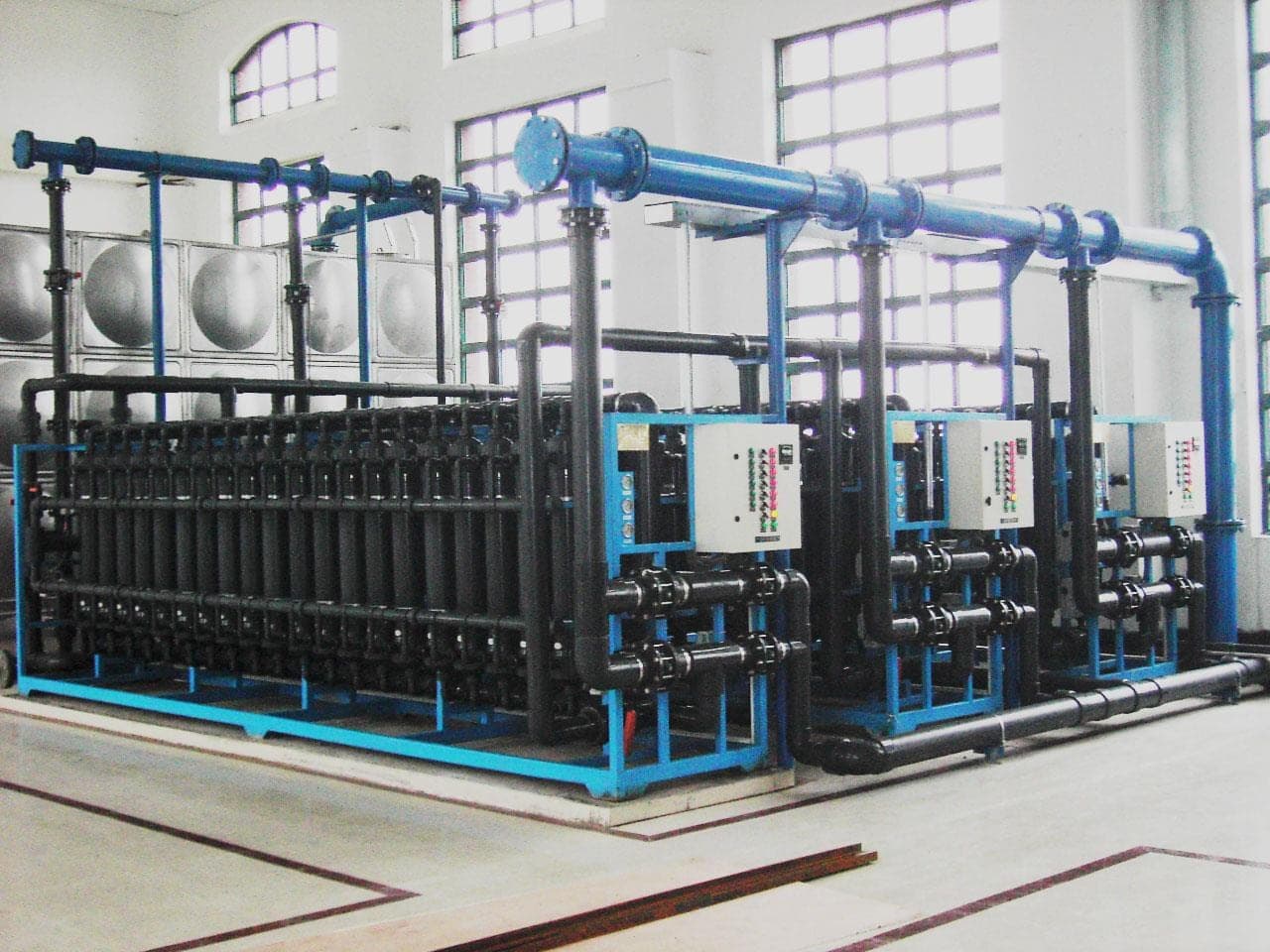
| 1. Pretreatment | Remove suspended solids, organics, hardness and silica | Multimedia filters, MF, UF, NF, softening, antiscalants, chemical precipitation | UF membranes; a UF pretreatment plant for RO desalination, China, 2007 |
| 2. Reverse osmosis | Recover the low-energy water first | RO | Conventional RO membranes |
| 3. Brine concentration | Take the RO reject toward saturation | MVC evaporator, or membrane distillation | AQUA-SEP VMD, for feeds of 25% salt and more |
| 4. Crystallization | Turn saturated brine into salt and recover the last water | MVC crystallizer | AQUA-SEP to saturation (290,000 ppm for NaCl), with salt crystallizing in its feed tank |
| 5. Solids handling | Separate and dry the salt | Solids separation, dryer | On Petro Sep's data sheet, solids separation follows AQUA-SEP |
What does a ZLD process flow diagram show?
A ZLD process flow diagram (PFD) shows the stages from saline feed to salt, with the water each stage recovers and the energy it uses.
Petro Sep's energy data sheet draws two such trains for a 100 GPM unit:
- Evaporator and crystallizer train: saline water → pretreatment → reverse osmosis (5 kWh/m³; 50% water recovery) → MVC evaporator (25 kWh/m³; 60%) → MVC crystallizer (18 kWh/m³; 99%) → moist salt → solids separation → salt.
- AQUA-SEP train: the pretreated feed goes straight to AQUA-SEP, or through RO first, with the RO reject going to an AQUA-SEP stage with mechanical vapor compression. The AQUA-SEP block is labelled 26 kWh/m³ and 90% water recovery. Its concentrate goes straight to solids separation, so on the sheet it takes the place of both the evaporator and the crystallizer.
What is hybrid ZLD?
Hybrid ZLD combines membrane and thermal steps in one train: membranes recover water first, so the costlier evaporation and crystallization handle a smaller stream.
In the words of the 2025 review by Panagopoulos and Michailidis, the membrane step "lightens the burden on the following, more expensive steps." Tong and Elimelech trace the "evolution of ZLD from thermal- to membrane-based processes."
The review describes RO with membrane distillation as "a complementary system where RO is employed for initial water recovery, and MD further concentrates the brine to near saturation levels." That is AQUA-SEP's role. Its brochure calls it "Easily integrated in hybrid zero liquid discharge process", and Petro Sep's RO presentation says RO reject can be routed to an AQUA-SEP unit, which could raise water recovery "up to ~95%". Petro Sep's configurations are on the hybrid ZLD page.
How much energy does ZLD use?
The bulk of a ZLD plant's energy goes into the stages after RO.
On Petro Sep's data sheet, RO uses 5 kWh/m³; the evaporator and crystallizer after it use 43 kWh/m³ of electricity plus 300 kWh/m³ of utilities.
| Route | Electrical energy (kWh/m³) | Utilities (kWh/m³) |
|---|---|---|
| Evaporator + crystallizer | 43 | 300 |
| AQUA-SEP | 26 | 129 |
| Stage | Energy (kWh/m³) | Water recovery, as labelled |
|---|---|---|
| Reverse osmosis | 5 | 50% |
| MVC evaporator | 25 | 60% |
| MVC crystallizer | 18 | 99% |
| AQUA-SEP, with MVC | 26 | 90% |
AQUA-SEP is lower on both lines. The data sheet does not break its utilities figure down. A 2020 study in Water Research puts mechanical vapor compression at 20 to 25 kWh of electricity per m³ of feed, to concentrate a saline stream from 0.1 to 1.0 M NaCl.
Under "Less Energy", Petro Sep's AQUA-SEP brochure lists a "Lower operating temperature, more transfer surface area, reuse of heat energy". Petro Sep's General Presentation adds that in VMD the latent heat from the blowers, compressors or pumps that move vapors and liquids is "captured and reused for other purposes within system". Membrane distillation can also use low-grade or waste heat (see the FAQ).
What drives ZLD cost?
ZLD cost follows the feed, the recovery target, the heat available, materials, scaling, plant size and disposal.
- Salinity and chemistry. The saltier the feed, the more pressure RO needs, until it reaches its limit. Hardness and silica, which form scale, shape the pretreatment the train needs.
- Recovery target. MLD stops at about 95% with membranes. ZLD gets the rest from evaporation and crystallization, which use far more energy than RO on Petro Sep's data sheet.
- Energy and heat. On the sheet's evaporator and crystallizer route, utilities (300 kWh/m³) outweigh electricity (43 kWh/m³). Capturing unused waste or low-grade heat can cut the energy membrane distillation draws.
- Materials. Petro Sep's comparison says evaporators must be built of corrosion-resistant materials such as duplex or super duplex stainless steel or Hastelloy C-276. AQUA-SEP's membranes are plastic (PE, PP, PVDF and others), with a super duplex or Hastelloy C-276 condenser.
- Scaling and cleaning. In the same comparison, evaporators carry a high operational cost from scale on their heat-transfer surfaces, which "leads to reduced energy efficiency and lower productivity", and they need frequent cleaning. AQUA-SEP membrane modules can be replaced with no system shutdown.
- Size. For evaporators, "Small capacity scale is not feasible due to high capital cost"; VMD is "Highly scalable, but small capacity scale is also feasible."
- Disposal. Petro Sep lists the "High cost and ability to dispose of highly concentrated brine" among the problems to address.
- Ownership. Petro Sep's 2024 General Presentation also lists build, own, operate, maintain (BOOM), priced per liter or gallon processed.
Capex and opex depend on all of these, so this guide gives no price ranges. A feasibility read on a sample is the way to a number.
ZLD vs MLD: what is the difference?
Minimal liquid discharge (MLD) stops at about 95% water recovery and leaves a small brine stream; ZLD adds evaporation and crystallization and leaves solids.
| ZLD | MLD | |
|---|---|---|
| Water recovery | Aims for "as much as 100%" | About 95% |
| Steps | Pretreatment, pre-concentration, evaporation, crystallization | Pretreatment and pre-concentration |
| Main technology | Membranes, then "mainly using heat-based processes" | "Membrane-based configurations" |
| What is left | "One or more solid salt products" | A concentrated brine to dispose of |
| Energy and cost | "High cost and intensive energy consumption" | Leaves out the "more expensive" evaporation and crystallization steps |
| Fits where | No liquid may leave the site | A small brine stream may still be disposed of |
| Petro Sep route | AQUA-SEP to saturation, then solids separation | RO plus AQUA-SEP, up to about 95% water recovery |
Petro Sep lists both ZLD and MLD as applications for AQUA-SEP. The review attaches a condition to MLD: it suits manufacturers "contingent upon the fulfillment of legal and environmental prerequisites". In practice, the remaining brine needs a legal outlet.
Why do plants adopt ZLD?
Plants adopt ZLD because disposal rules are tightening, fresh water is scarce, brine is costly to get rid of, and the water and salts have value.
- Rules. Petro Sep's General Presentation names "Tougher Disposal Regulations". In the United States, EPA's 2024 rule for coal-fired power plants set zero discharge limitations for three wastewaters (see the FAQ).
- Water. Plants in arid regions or with limited fresh water "increasingly adopt ZLD/MLD technologies to optimize water recovery" (Panagopoulos and Michailidis).
- Disposal cost and harm. Brine is costly to dispose of, and Petro Sep's RO presentation warns that RO reject returned to the sea harms marine life.
- Value. Recovered water goes back into the process, and Petro Sep counts the "Recovery of valuable waste streams" among the drivers.
Which industries use ZLD?
ZLD is used in desalination and industry; a 2025 review names the manufacturing and energy production sectors, and the first systems were at US power plants.
Petro Sep's documents list these applications for AQUA-SEP:
- Desalination and RO reject: the reject of RO desalination plants and the concentrated brine of thermal desalination plants.
- Oil and gas: produced water from tight oil, shale gas and coalbed methane, including recovering water for reuse as steam to produce bitumen.
- Mining: mine tailings, mining wastewater and lithium recovery.
- Chemical plants: water removal from acids (succinic, adipic, propanoic, sulfuric) and bases (sodium hydroxide), up to caustic soda solids, or acid hydrate crystals when VMD is paired with a crystallizer and dryer in a hybrid ZLD system.
- Industrial wastewater: high-TDS toxic wastewater, and industrial wastewater with high salts and inorganic chemicals.
What are the limits of ZLD?
ZLD's limits are cost and energy, scaling, mixed salts, and the solid waste and emissions it leaves behind.
- Cost and energy. Tong and Elimelech: the technology "is constrained by high cost and intensive energy consumption."
- Scaling. Calcium carbonate, calcium sulfate and silica are common scale-formers on membranes, and evaporator heat-transfer surfaces scale too, so the train needs pretreatment matched to the feed.
- Mixed salts. Pure, saleable salts take design; otherwise the product is a mixed solid (see the FAQ on salt).
- Waste and emissions. Tong and Elimelech list "greenhouse gas emission and generation of solid waste" among ZLD's potential environmental impacts.
- When MLD is enough. Where a small brine stream can legally be disposed of, MLD leaves out evaporation and crystallization.
What does Petro Sep supply for a ZLD train?
Petro Sep builds the brine end of a ZLD train around AQUA-SEP, which can concentrate RO reject and other brines to saturation, the point at which salt starts to crystallize.
AQUA-SEP is a hollow fiber vacuum membrane distillation system. The feed runs along hydrophobic, microporous hollow fibers with a vacuum on the other side; water vapor passes through the pores to a condenser and almost all of the dissolved salts stay behind. Petro Sep integrates VMD with zero liquid discharge systems "up to the point of crystallization" (AQUA-SEP presentation). Its General Presentation marks "Crystallization In Feed Tank" at the salty end of AQUA-SEP's range, beside a photo of a saturated reject that "creates salt crystals".
AQUA-SEP in a ZLD train, from Petro Sep's documents:
- Feed: brines of 25% salt and more.
- Brine: concentrated to saturation; the brochure's comparative example takes a 40,000 ppm feed to saturation (290,000 ppm for NaCl).
- Product water: under 10 ppm in the same example.
- Recovery: 85 to 90%+ total feedwater recovery; RO plus AQUA-SEP could reach up to about 95%.
- Operation: about 70 °C, with a maximum brine temperature of 70 °C in the example; no chemical descalants; membrane modules can be replaced with no system shutdown.
- Size: plants from 50 to 1,000 m³/day; in the example, 100 m³/day fits in two skids, 5.5 × 5.5 × 5 m and 6.5 × 2.5 × 5 m.
- Pretreatment: required.
Petro Sep works turnkey, from research and feasibility through FEED, detailed engineering and fabrication to construction and operations management. Systems, sizes and options are on the ZLD systems page.
AQUA-SEP and pretreatment projects
From Petro Sep's 2024 company profile and its 2023 website photo list:
- Saudi Arabia, 2002. AQUA-SEP, "Modular Skid for Seawater Desalination." See the Saudi Arabia desalination pilot.
- China, 2008. AQUA-SEP, "Full Scale Membrane Skids Installation for RO Reject Water Treatment & Brine Concentration." See the China brine concentration plant.
- China, 2014. AQUA-SEP, "Membrane Skid Testing for Industrial Waste & Brine Concentration."
- Rhode Island, USA, 2014. AQUA-SEP, "Mobile Hazardous Water Treatment Plant Vacuum Skid." See the Rhode Island mobile vacuum skid.
- Pretreatment, China, 2007 and 2015. A UF pretreatment plant for RO desalination (2007) and pretreatment plants for mining water (2007 and 2015).
Petro Sep's lab tests on frackwater
Petro Sep's General Presentation (2024) reports lab tests on three frackwater samples, with 80 to 90% of the water recovered from feeds of 2.4 to 13.8% salt.
| Sample | Feed salt | Product water salt | Water recovered |
|---|---|---|---|
| Marcellus | 2.4% | 0.001% | 90% |
| Texas | 8.1% | 23 ppm | 88% |
| Western Canada | 13.8% | 7 ppm | 80% |
How do you start a ZLD project?
Start with a sample: testing the stream helps show whether ZLD, MLD or brine concentration alone fits your plant.
Send a sample or the data, with:
- flow rate, TDS and the main ions, including hardness and silica;
- organics, oil and suspended solids;
- temperature, and any waste heat on site;
- the recovery you need, and your disposal route and its cost;
- energy price, space, the regulatory driver and the timeline.
Frequently asked questions
What is the full form of ZLD?
Is zero liquid discharge required by law?
What happens to the salt from a ZLD plant?
How much water does a ZLD system recover?
Can ZLD recover solvents as well as water?
Can a ZLD plant run on waste heat?
Does ZLD need pretreatment?
Can ZLD be added to an existing RO plant?
Sources
- Petro Sep, AQUA-SEP® brochure.
- Petro Sep, AQUA-SEP® energy consumption comparison data sheet (100 GPM unit).
- Petro Sep, AQUA-SEP® vacuum membrane distillation presentation.
- Petro Sep, AQUA-SEP® and reverse osmosis presentation.
- Petro Sep, General Presentation (2024).
- Petro Sep, Company profile (2024).
- Petro Sep, VOC-SEP® brochure.
- Petro Sep, AZEO-SEP® brochure.
- Tong and Elimelech, The Global Rise of Zero Liquid Discharge for Wastewater Management: Drivers, Technologies, and Future Directions (Environmental Science & Technology, volume 50, issue 13, pages 6846 to 6855, 2016).
- Panagopoulos and Michailidis, Membrane Technologies for Sustainable Wastewater Treatment: Advances, Challenges, and Applications in Zero Liquid Discharge (ZLD) and Minimal Liquid Discharge (MLD) Systems (Membranes, volume 15, issue 2, article 64, 2025, open access).
- Wang, Deshmukh, Du and Elimelech, Minimal and zero liquid discharge with reverse osmosis using low-salt-rejection membranes (Water Research, volume 170, article 115317, 2020).
- US Environmental Protection Agency, Fact sheet: Final Rule: Effluent Limitations Guidelines and Standards for the Steam Electric Power Generating Category (April 2024).
- US Environmental Protection Agency, Steam Electric Power Generating Effluent Guidelines: Deadline Extensions Rule (final rule published December 23, 2025; page last updated October 1, 2026).