By the Petro Sep engineering team
Published Updated
What is Vapor permeation?
Vapor permeation (VP) is a membrane separation technique used to concentrate or separate valuable compounds that are present as saturated vapor in the feed. It uses a nonporous membrane, with a chemical potential that creates a partial pressure difference across the membrane as the driving force, so both the feed and the permeate are in vapor form. Because the membrane contacts the feed as a vapor rather than a liquid, VP saves condensation energy and minimizes concentration polarization.
How vapor permeation works
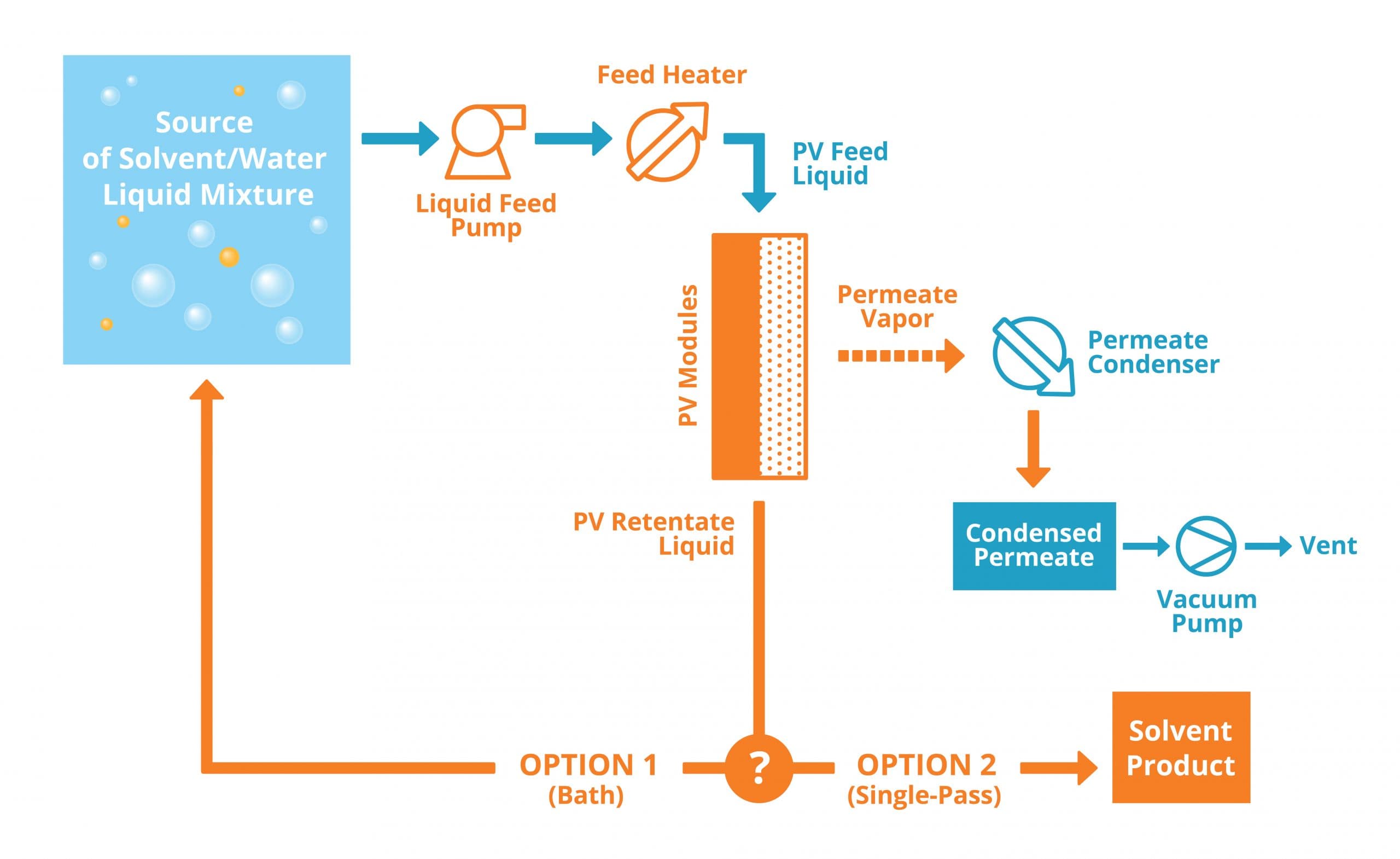
Vapor permeation uses a nonporous membrane. The separation is driven by a chemical potential that produces a partial pressure difference across the membrane, and mass transport through the membrane is governed by three steps: sorption, diffusion, and desorption. Target compounds sorb into the membrane on the feed side, diffuse through it, and desorb on the permeate side. Because the membrane is in contact with a feed in the vapor state, VP saves condensation energy and reduces concentration polarization at the membrane surface. These are the same transport principles used in pervaporation; the difference is the phase of the feed.
Vapor permeation vs. pervaporation
The core distinction is the state of the feed. In vapor permeation the feed is a vapor, or a mixture of vapor and gases, and the permeate obtained is also a vapor. In pervaporation the feed is a liquid mixture and the permeate is drawn off as a vapor. Keeping the feed in the vapor phase gives VP higher selectivity than PV, though the flux is typically lower. Vapor contact also avoids membrane swelling and the increased concentration polarization seen with liquid feeds, which helps extend membrane lifespan.
Common applications
Vapor permeation is a strong fit wherever the feed is already a vapor. Typical uses include purifying the top products of a fractionating column, which arrive as vapor; separating mixtures with low vaporization enthalpy such as ethanol-water and methanol-water; and dehydrating solvents using hydrophilic membranes. VP is also used in hybrid distillation configurations and to retrofit existing processes, where it can lower equipment cost, reduce maintenance requirements, and shrink the plant footprint.
Why engineers choose vapor permeation
VP belongs to Petro Sep’s family of membrane-based separations, which it positions as a greener route to industrial fluid separation with low operational cost and high-quality end products. For vapor feeds specifically, VP delivers high selectivity, avoids the energy penalty of re-condensing the feed, and protects the membrane from swelling. Paired with distillation as a hybrid step, it can be an economical option that reduces capital equipment, maintenance, and space compared with a stand-alone thermal separation.
How Petro Sep applies vapor permeation
Petro Sep develops membrane families that are offered in both pervaporation and vapor permeation configurations. AZEO-SEP and VOC-SEP membranes primarily use PV, can also operate in VP mode, and are catalogued as PV/VP membranes. Because vapor permeation shares the sorption, diffusion, and desorption mechanism of pervaporation, Petro Sep can scope, engineer, fabricate, and operate VP-based separation for solvent dehydration, VOC recovery, and column-overhead purification as part of an integrated process solution.
Key points
- Vapor permeation (VP) separates compounds that are present as saturated vapor in the feed, and the permeate leaves as a vapor too.
- The driving force is a chemical potential that creates a partial pressure difference across a nonporous membrane.
- Mass transport follows sorption, diffusion, and desorption, the same mechanism as pervaporation.
- VP offers higher selectivity than pervaporation but lower flux; feeding vapor avoids membrane swelling and cuts concentration polarization, extending membrane life.
- In VP the feed is vapor and the permeate is vapor; in pervaporation the feed is liquid and the permeate is vapor.
- Common uses: purifying fractionating-column top products, separating low vaporization enthalpy mixtures like ethanol-water and methanol-water, and solvent dehydration with hydrophilic membranes.
- Feeding vapor directly saves condensation energy, making VP a good fit for hybrid distillation and retrofits with lower equipment cost, less maintenance, and a smaller footprint.
How Petro Sep applies this
Petro Sep offers vapor permeation as part of its thermally driven membrane portfolio. Its AZEO-SEP and VOC-SEP membrane families are supplied in PV/VP configurations, so the same sorption-diffusion-desorption chemistry can be applied to vapor feeds for solvent dehydration, VOC recovery, and purifying column-overhead vapor. As a process-solutions company, Petro Sep can research, engineer, fabricate, and operate a VP separation stage, including hybrid distillation setups, as a single integrated scope.
Sources
- Petro Sep, Membrane Technologies (petrosep.com page, replaced in July 2026).
- Petro Sep, Products & Systems (petrosep.com page, replaced in July 2026).