
The cellulosic problem, briefly
Cellulose and hemicellulose from straw, bagasse, corn stover, and forestry residues can be hydrolyzed into fermentable sugars and fermented to ethanol. The biology is solved. What is not solved is the cost stack: pretreatment, enzyme load, fermentation residence time, and downstream separation all stack against the final litre of fuel-grade product. Of those, separation is the single largest energy line in most published process designs.
The fermentation broth is dilute (typically 4 to 10% ethanol by weight), the ethanol/water azeotrope sits at 95.6% ethanol, and fuel-grade specifications require ~99.5%+ anhydrous ethanol. Three concentration steps, each with a distinct economic profile, in a single train.
Where distillation alone struggles
Conventional ethanol dehydration breaks the ethanol/water azeotrope with either an entrainer (benzene, cyclohexane) or pressure-swing distillation. Both work. Both carry baggage. The entrainer route requires an additional column, an entrainer makeup loop, and the storage, permitting, and disposal that come with handling a regulated co-solvent at industrial scale. Pressure-swing avoids the entrainer but multiplies column count and ties the design to a fairly narrow operating envelope.
On the fermentation off-gas side, distillation does not help at all. Volatile organic compounds (VOCs) carried off the fermenter (ethanol, acetone, other ferment products) need a different capture and recovery approach if the operator wants to recycle them into product yield rather than vent or burn them.
Where AZEO-SEP® and VOC-SEP® earn their place
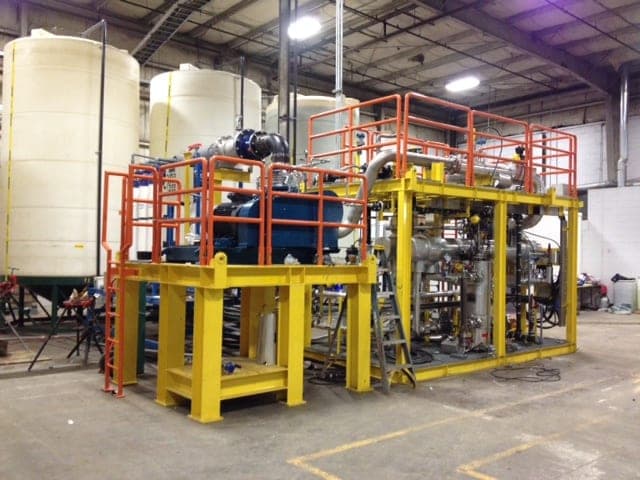
Petro Sep’s AZEO-SEP® platform uses a dense, hydrophilic pervaporation membrane to selectively pull water out of the liquid ethanol stream past the 95.6% azeotrope, to 99.5%+ ethanol purity in a single pass. No entrainer. No third column. The skid replaces the azeotropic distillation stage of a conventional train. Operating temperature 75 to 85 °C. Payback on alcohol dehydration plants runs under one year on the energy and entrainer-disposal savings alone.
VOC-SEP® uses a hydrophobic pervaporation membrane to do the opposite job: pull ethanol and other VOCs out of the aqueous fermentation broth, recovering them at greater than 99.5% purity, ready to be returned to product. The platform was validated on three industrial wastewater feeds (Toronto, Tomlinson, Chateauguay) at Petro Sep’s Sarnia “Lean Water” pilot over six months, recovering 70% of the feed as clean discharge water and 95% of organics as high-BTU fuel. Pre-membrane alcohol concentrations ran 4,400 to 108,240 ppm; post-membrane discharge ran 43 to 247 ppm.
A complete cellulosic train
A membrane-enhanced cellulosic ethanol train Petro Sep has scoped pairs five components: a hydrolysis front-end (existing licensor of customer’s choice), a fermenter (existing licensor), VOC-SEP® on the aqueous side streams to capture ferment products, AZEO-SEP® on the bulk ethanol stream for the azeotrope break, and a lignin boiler to convert the cellulosic solids back into process heat. The boiler closes the energy loop on the non-fermentable lignin fraction that would otherwise be a disposal cost.
Scaled to a 100 ton-per-year demonstration capacity, the configuration reduces total separation energy by roughly half versus a comparable distillation-only design. The single-skid AZEO-SEP® replaces a two-column azeotropic distillation arrangement plus its entrainer recovery loop, eliminating both the capital line and the operating overhead of entrainer handling.
The Fiberight pilot
Petro Sep collaborated with Fiberight on cellulosic ethanol pilot work in the United States. The pilot proved out the combination of fermentation feedstock handling and membrane-enhanced recovery on a real, continuously-running stream. The configuration validated the approach: pervaporation handles the bulk dehydration; the rest of the train is conventional and vendor-neutral.
Operators evaluating cellulosic ethanol facility economics today should pencil out the separation section explicitly, not as a fixed-percentage line item. The membrane train option carries lower energy, lower entrainer risk, and a smaller column footprint than the distillation default. The capital line is higher per kilowatt of installed equipment but lower per litre of finished product.
What we offer next
If you are scoping a cellulosic ethanol facility, a fermentation product recovery system, or a related solvent-and-water separation problem, we will return a sized recommendation and a real-feed pilot proposal promptly. Send the fluid composition, the target capacity, and the project schedule. We will tell you whether AZEO-SEP®, VOC-SEP®, or a hybrid with conventional distillation is the right fit. If our scope is not the right answer, we will say that too.